APPA Cleaning Levels Explained: How Universities Should Staff Custodial Services
The short answer: APPA — the association for educational facilities professionals — defines five measurable levels of cleanliness, from Level 1 ("Orderly Spotlessness") to Level 5 ("Unkempt Neglect"), plus production rates that convert a target level into staffing numbers. Most campuses target Level 2 for general space. The right way to staff a campus is a bottoms-up work-loading analysis: inventory every space, assign each a target level, apply APPA production rates, and build schedules from the result. Institutions that skip this step almost always end up either over-paying for coverage they don't need or under-staffed in the spaces students and visitors actually judge them by.
What Is APPA?
APPA, known today as Leadership in Educational Facilities, is the professional association for the people who run college, university, and school campuses. Its custodial standard, Operational Guidelines for Educational Facilities: Custodial, is in its 4th edition (2023). It began in 1992 as the Custodial Staffing Guidelines with 10 room types; the current guidelines cover 23. When a campus says it cleans "to APPA standards," this is the document it means.
The Five APPA Levels
APPA's guidelines give facilities leaders a shared, objective vocabulary for "how clean is clean." Each level has a written appearance description, which makes it enforceable in a contract — you can inspect against it and score it.
| Level | Name | What It Looks Like | Typical Use |
|---|---|---|---|
| 1 | Orderly Spotlessness (Showpiece Facility) | Floors shine, no dust or streaks anywhere, fixtures gleam. Cleaned to a healthcare-adjacent standard. | Showcase lobbies, executive suites, child care, labs |
| 2 | Ordinary Tidiness (Comprehensive Care) | Clean and presentable; minor dust or marks visible only up close. | The standard target for most campus space |
| 3 | Casual Inattention (Managed Care) | Noticeable dulling, dust, and smudges; still functional. | Low-traffic support and storage areas |
| 4 | Moderate Dinginess (Reactive) | Visible dirt buildup, dull floors, marred walls. | A budget-driven compromise, not a design choice |
| 5 | Unkempt Neglect (Crisis) | Sustained neglect; cleaning is essentially reactive only. | What deferred custodial budgets eventually produce |
Level 1 vs. Level 2 in Practice
Most disputes about "clean" are really disputes about the difference between these two levels, so it helps to know what an inspector actually checks. In our own words, summarizing APPA's descriptions:
- Floors and baseboards. Level 1: bright, fresh colors, nothing built up anywhere. Level 2: still bright with no buildup in corners, but a day or two of light dust or streaks is acceptable.
- Walls, desks, and other surfaces. Level 1: freshly cleaned, no dust, smudges, or fingerprints. Level 2: clean, with marks you only notice up close.
- Restrooms. At both levels, fixtures and tile are clean and odor-free and supplies are stocked. Restrooms are where the two levels converge, and where complaints start when they don't.
- Trash. At both levels, containers hold only the current day's waste.
Below Level 2 the change is obvious to any visitor: Level 3 shows buildup along walls and dull walking lanes, and by Level 4 containers smell sour and some lights are out.
From Level to Headcount: How Work-Loading Works
The levels only become a budget when you apply production rates — how much area one custodian can service per shift at a given level for a given space type. As a rough orientation, commonly cited APPA benchmarks run from about 10,000–11,000 square feet per custodian per shift at Level 1 to roughly 45,000–50,000 square feet at Level 4, with Level 2 falling in between. Restrooms, labs, and food service areas consume far more labor per square foot than corridors or open offices, which is why a single blanket ratio for a whole campus is always wrong.
APPA's own staffing tables make the point. Here is how much cleanable floor area one full-time custodian can cover at each level, for a few of the 23 space types:
| Space type | Level 1 | Level 2 | Level 3 | Level 4 |
|---|---|---|---|---|
| Restroom | 2,579 | 3,303 | — | — |
| Research lab | 6,247 | 8,521 | 10,184 | 14,594 |
| Office | 9,411 | 16,930 | 30,959 | 41,775 |
| Classroom | 10,279 | 21,306 | 38,513 | 50,341 |
| Corridors and public circulation | 72,036 | 115,889 | 132,461 | 172,481 |
Cleanable square feet per custodian FTE. Source: APPA, Operational Guidelines for Educational Facilities: Custodial (4th ed., 2023), as summarized in APPA's Cleaning Operations chapter (August 2024). APPA does not rate restrooms below Level 2.
A custodian who can hold 116,000 square feet of corridor at Level 2 can hold only about 3,300 square feet of restrooms at the same level. Averaging those into one number is how campuses end up with spotless hallways and complaints about restrooms.
At CSS, work-loading is step one of a six-step staffing methodology we apply to every contract:
- Work-Loading — space-by-space inventory with APPA production rates applied to each area's target level.
- Productive Manning — converting workload hours into a staffing plan with relief factors for vacation, sick time, and training, so coverage doesn't collapse when someone is out.
- Master Job Assignments — every employee assigned to a specific building, floor, and shift.
- Individual Schedules — laminated, attached to each work cart.
- CAD Overlay Schedules — visual zone maps for complex campuses.
- Periodic Schedules — a full-year calendar for non-routine work like carpet extraction and floor refinishing.
When a contractor can't show you this math in their proposal, their price is a guess — and the shortfall will surface as missed service after award, not before it.
Using APPA Levels in an RFP
Specify levels by space type, not campus-wide
A well-written solicitation assigns Level 1 to the spaces that carry your reputation (admissions lobby, president's suite, recital hall), Level 2 to classrooms and offices, and Level 3 where it genuinely doesn't matter. This is also where budget-neutral redesign lives: within the same spend, service can be shifted from low-visibility areas to the spaces that drive perception. On our contracts we revisit this mix with the client rather than waiting for a complaint — CSS's average quality score across inspected work is 96%, and that number is a product of putting hours where they matter.
Require the work-loading math
Ask bidders for their production-rate assumptions, FTE counts by building and shift, and relief factors. Two proposals with the same bottom line can hide radically different coverage.
Define measurement after award
An APPA level is only enforceable if someone inspects against it. CSS runs continuous, overlapping inspections through a real-time, web-based quality control system that clients can log into — quality scores, deficiency identification, and trend analysis are visible to the customer, not filed in a drawer. Pair inspections with hard metrics — ATP surface testing, slip meter readings versus OSHA thresholds, and indoor air quality checks — and "clean" stops being an argument about opinions.
Is There Software for APPA Cleaning Levels?
Yes, and plenty of it scores inspections. The software matters less than four things it has to do. It should set the target level by space type, not campus-wide. It should score inspections against the written APPA descriptions, not a vague pass/fail. The client should see the results directly, as they happen. And, ideally, it should know which spaces were actually used, so the inspection schedule follows real traffic.
We run all four in Facility Hub Live, CSS's own system: live quality scores, sensor alerts, and response times that the client sees on the same screen we do. The bigger shift is the last point. When occupancy sensors show a lecture hall sat empty all day, it doesn't need Level 1 attention tonight; when a restroom saw three times its usual traffic, it does. That is the idea behind letting usage set the level, which we walk through in this episode:
Episode 3 of The Living Campus · 7 min · What is a Living Facility?
Where Staffing Is Headed
Static staffing plans assume every space is used the same way every day — a fiction on any modern campus. Occupancy sensors now tell us which restrooms and conference rooms were actually used, so labor flexes to demand instead of a fixed route, and autonomous scrubbers handle long corridor runs with validated trip reports. That combination is how service levels rise within the same budget; we cover it in depth in How AI, Sensors, and Autonomous Equipment Are Changing Custodial Services. The staffing model of the next decade is engineered, measured, and sensor-informed — and APPA's levels remain the yardstick it's all measured against.
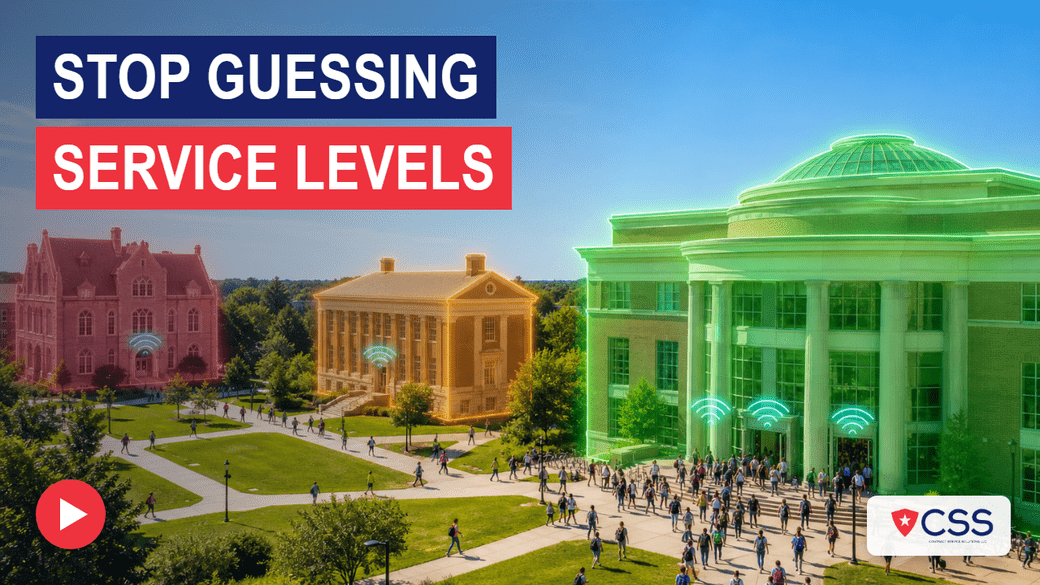 Watch the episode · 7 minStop Guessing Your APPA Level: Is Your Budget Paying for Cleaning You Don't Need?
Frequently Asked Questions
What are the five APPA cleaning levels?
Level 1 Orderly Spotlessness, Level 2 Ordinary Tidiness, Level 3 Casual Inattention, Level 4 Moderate Dinginess, and Level 5 Unkempt Neglect. Most institutions target Level 2 for general campus space and Level 1 for showcase or healthcare-adjacent areas.
What is APPA?
APPA (Leadership in Educational Facilities) is the professional association for facilities leaders at colleges, universities, and schools. Its Operational Guidelines for Educational Facilities: Custodial, now in its 4th edition (2023), define the five levels most campuses use.
What does APPA Level 2 cleaning look like?
Floors are bright with no buildup in corners, though a day or two of light dust or streaks may show; surfaces are clean with marks visible only up close; restrooms are clean, odor-free, and stocked; and trash holds only the current day's waste.
How many square feet can one custodian clean?
It depends on the target APPA level and space type. Commonly cited APPA benchmarks range from roughly 10,000–11,000 square feet per custodian per shift at Level 1 to 45,000–50,000 at Level 4. Accurate staffing requires a space-by-space work-loading analysis using APPA production rates rather than a single blanket ratio.
How many square feet can one custodian clean at APPA Level 2?
It depends on the space: roughly 16,900 cleanable square feet for offices, 21,300 for classrooms, 3,300 for restrooms, and about 115,900 for corridors, per APPA's staffing tables. That spread is why a single campus-wide ratio is always wrong.
How should an APPA level be written into a custodial RFP?
Specify the target level by space type, require bidders to show their work-loading math, and define how the level will be measured after award, such as scored inspections against the APPA descriptions.
Is there software for APPA cleaning levels?
Yes. Inspection software can score each space against the APPA descriptions and track results over time. Look for levels set by space type, scoring against the written descriptions, results the client can see, and ideally sensor data showing which spaces were used.
Where can I get the official APPA cleaning standards?
APPA publishes Operational Guidelines for Educational Facilities: Custodial (4th edition, 2023) through its online bookstore and offers custodial guidelines training. See APPA's Cleaning Operations page.
Want your campus work-loaded properly?
CSS builds APPA-based, open-book custodial programs for universities, federal facilities, and institutions nationwide. Average management experience: 21 years. Employee retention: 94%.
Request a Quote Watch the Video Series